


Finding Grace's Ford

A stranger at the door, a 1956 receipt, and a 1928 Model A Ford Phaeton that may be finding its way back to Great Barrington.
A Knock on a Summer Friday
It began, as the best stories do, with a knock on the door.
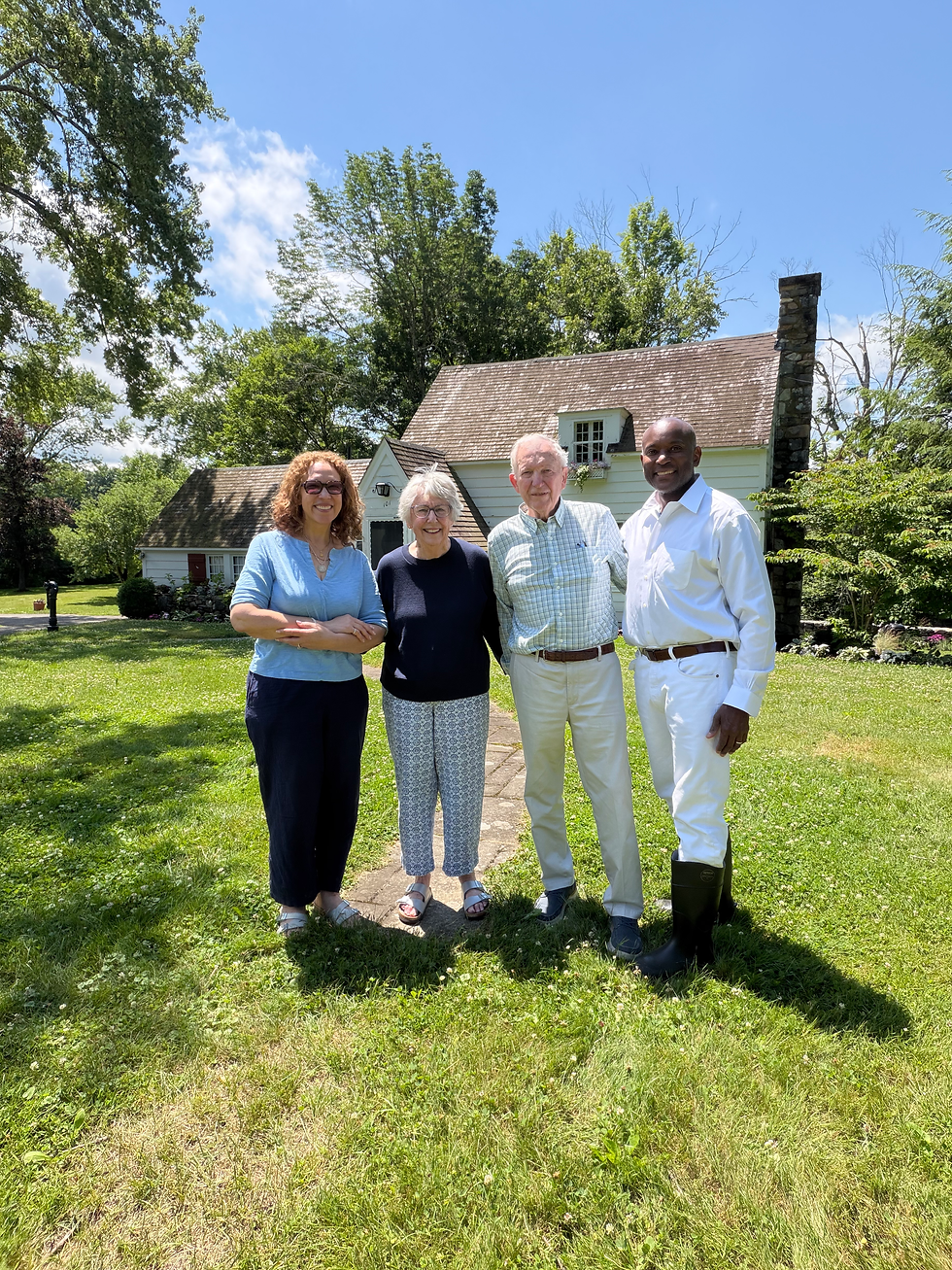
On a Friday in July, Rufus E. Jones Jr., president of the James Weldon Johnson Foundation, and Jill Rosenberg Jones, its chairperson and treasurer, opened the door of their home in Great Barrington, Massachusetts. An older gentleman had been knocking and stood on the step.
He introduced himself as Bruce Wood and explained that he had come to cross something off his bucket list. In 1956, he said, he bought Grace Nail's car from her. He had been tracing her history for years without much success; he had found the Foundation online, and so here he was.
He and his wife were on their way to Tanglewood. Rufus and Jill invited them inside, and Rufus walked them out to the small writing cabin where James Weldon Johnson once worked. Standing there, Bruce offered something no one had expected.
He was the original owner of Grace Nail Johnson’s Ford Model A Phaeton. He knew where the car was; he told them. More than that, he knew the car's other owners who were still living, and together they could trace its ownership from Grace's hands to the present day.
The car was on Cape Cod, close enough, as it turned out, to bring the whole story within reach.
Seventy Years of Wondering
Bruce Wood first saw the Ford as a young man working a summer job in Great Barrington. He could not stop thinking about it. So he did the only thing he could: he left a note on the car. If you ever want to sell it, he wrote, here is how to reach me.
A year went by. Then a letter arrived from Grace. She had received other offers, she told him, but he had been the first to ask, and so the car was his if he was still interested.
On Monday, August 20, 1956, Bruce put down a ten-dollar deposit on the "Ford Touring Car" at "Crossroads," on Seekonk Road in Great Barrington. The price was $150. The balance of $140 was due on delivery.
On September 15, 1956, he paid the balance in full. The seller signed both receipts herself: Grace Nail. Bruce gave the car the only name that made sense. He called it "Grace."
She told him the car had been a birthday present from her husband. The detail stayed with Bruce. Who, at the end of the 1920s, could afford to buy a new car as a gift? He went looking for the answer, and for her. For decades he found nothing.

In the end, the answer came through a song. Bruce, by then living in a senior community in Massachusetts, went to an evening concert. The choir sang "Lift Every Voice and Sing." Before they began, the choir leader spoke about the man who wrote the song, James Weldon Johnson, and mentioned his wife, Grace Nail Johnson.
Bruce heard the name and knew. After all those years, there she was.
He looked up Grace Nail Johnson, found the address of the Johnson home in Great Barrington, and made himself a promise: I will go there. And one Friday in July, on the way to Tanglewood, he did.
A Birthday Gift

For the James Weldon Johnson Foundation, this story begins with the man whose name we carry. James Weldon Johnson, poet, novelist, diplomat, lawyer, educator, activist, and civil rights leader, wrote the words to "Lift Every Voice and Sing" in 1900, set to music by his brother, J. Rosamond Johnson. Cherished as the “National Hymn,” it has been sung for well over 125 years. As the NAACP's first Black executive secretary, he led the organization through the 1920s, including its campaign against lynching.
Grace Nail Johnson stood beside her husband as a partner in every sense. Born Grace Elizabeth Nail on February 27, 1885, the daughter of Harlem real estate pioneer John B. Nail, she married James Weldon Johnson in 1910. A patron of the Harlem Renaissance and an advocate in her own right, she devoted nearly four decades after his passing to preserving his legacy, work the Foundation is proud to carry forward today.
Each summer the Johnsons retreated to Five Acres, their home in Great Barrington. There, in a small cabin set apart from the house, James Weldon Johnson wrote. It is the same cabin Rufus showed Bruce Wood that Friday in July.
As Bruce recalls Grace telling it, the Ford was a birthday gift from her husband, around 1928 or 1929. The car's body is date-stamped July 17, 1928, and Grace's birthday fell in late February, so a gift in February 1929 would fit.
The car also calls to mind a profound loss. On June 26, 1938, while the Johnsons were traveling in Wiscasset, Maine, a different car, which Grace was driving, was struck by a train at a crossing. James Weldon Johnson lost his life, and Grace was seriously injured. She carried on, and kept her Ford Model A Phaeton in Great Barrington for nearly two more decades, until she sold it to Bruce Wood in 1956.
The Car and What It Meant

The Model A was the most anticipated car of its age. Ford had built the Model T for 18 years; when it finally ended, the company shut down to retool, and the new car was unveiled on December 2, 1927, as a 1928 model. Crowds lined up to see it. By February 1929, a million had been sold, and nearly 4.9 million were built before production ended in 1932.
It was a modern machine for its day: a 40-horsepower, four-cylinder engine, a top speed of about 65 miles per hour, safety glass in the windshield, and the standard pedal layout drivers still use. The Phaeton was Ford’s open touring car, four doors, room for five, and a folding fabric top, with snap-on side curtains in place of glass windows.
For the Johnsons, a car meant something more. In the Jim Crow era, Black travelers faced segregated rail cars, refused service, and constant indignity. An automobile offered autonomy: the freedom to move on one's own terms. Decades later, Ebony would describe a car as "a solid and substantial symbol" of equal standing. The need was great enough that by 1936 a guide for Black motorists, The Negro Motorist Green Book, began mapping where one could safely eat, sleep, and buy gas.
Seen that way, a new Ford James Weldon Johnson gave Grace was not only a birthday present. It was a portrait of a couple who had built lives of accomplishment, and who claimed the open road as their own.
The Paper Trail
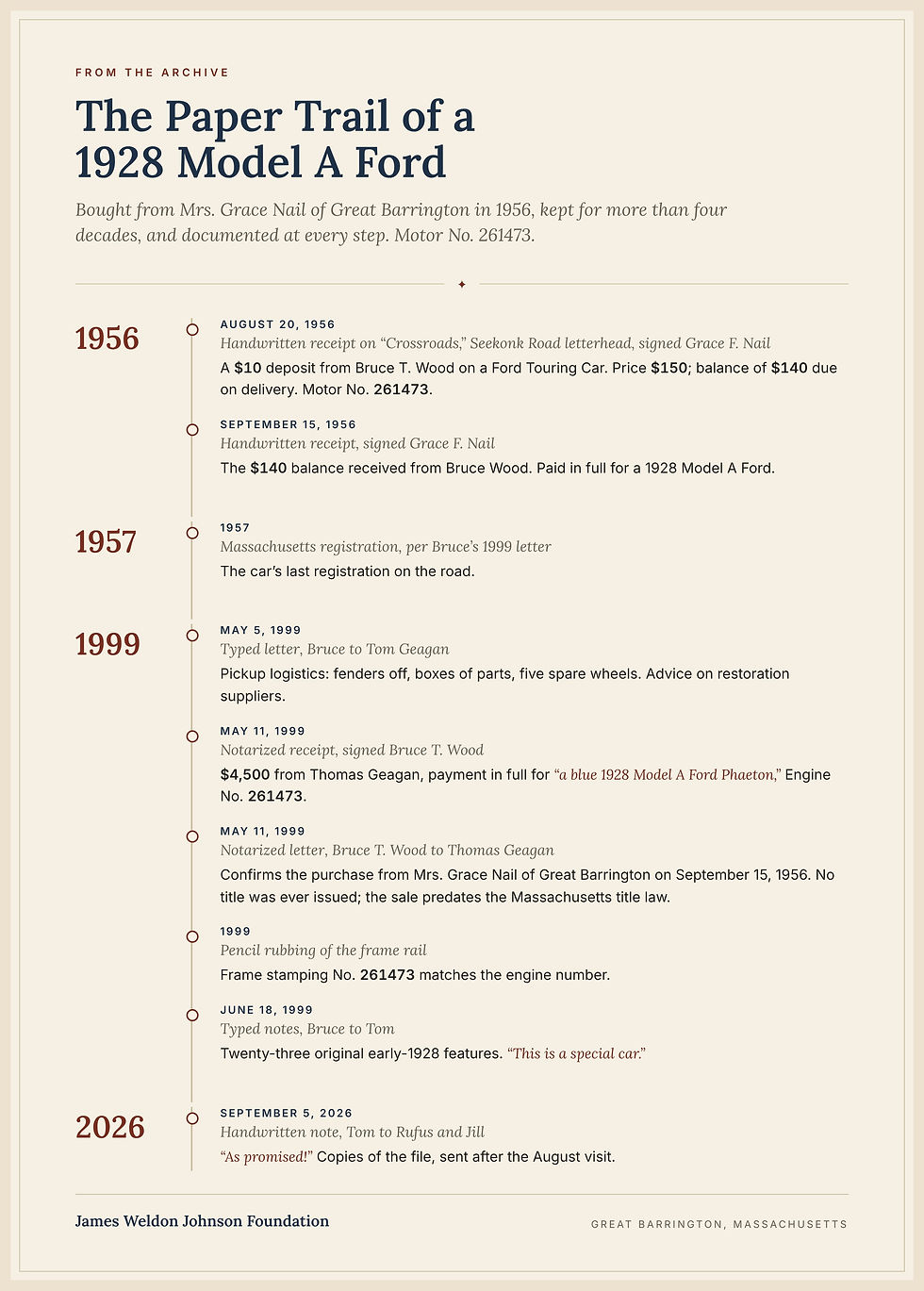
Bruce’s June 1999 list is a collector's love letter. Among the originals he counted:
The Zenith carburetor, Powerhouse generator and coil with slanted posts
A Bakelite distributor cap with the Ford script in two places, used only through October 1928
A motor meter bearing the name of the Great Barrington dealer
The speedometer, reading about 33,000 miles
The tapered muffler; later replacements were cylindrical
The upper radiator hose and clamps, "probably never been removed or changed"
A rare round medallion for the front bumper, kept in a box of hood brackets
A riveted cover to the left of the clutch pedal, he noted, hides the hole where the early brake lever sat. "This kind of trivia is what keeps my car juices flowing," he wrote. "This is a special car."
Cape Cod, August 21

Rufus and Jill already had a trip to Martha's Vineyard planned for August. They simply left early and stopped on Cape Cod.
On Friday, August 21, they went to the home of the car's second owner, Tom Geagan, and spent time with him and his wife. Tom had bought the Phaeton from Bruce in May 1999, fenders off and parts in boxes, and had kept every letter Bruce sent him. Tom restored the car to a pristine state.
Then Bruce invited them to meet his friend, the man who owns the car today. So they went to meet him: Karl Kovack.
And there it was. After seventy years, three owners and one long search, Grace Nail Johnson's Ford sat gleaming in a garage, restored to pristine condition.
Everyone in that garage shared the same affliction: they are enthusiasts, the kind of people for whom a hexagonal timing-pin head or a two-tang oil cap is worth a paragraph. The Johnson Foundation's leaders had come for history. They found a small fellowship of people who had been caring for it all along.
The Car Today
The car is a 1928 Ford Model A Phaeton, the open touring body of Ford's great successor to the Model T. It has a retractable fabric roof, one that, remarkably, has never been lowered.
What makes it special now is how honest it is. Everything on it is mechanical. There are no exterior door handles; you reach over and open the door from inside. The spare tire mounted on the back is the original, a reminder of what roads were like in the late 1920s and '30s, when a flat was not a question of if but when.
The restorer painted the body in its original color. Modern color-matching technology made it possible to recover the exact shade the factory used. The only original upholstery that remains is the leather trim along the door and the red steering wheel.
Collectors prize early 1928 cars because Ford changed parts constantly in that first year. That is why Bruce Wood's list matters so much. The distributor cap with the Ford script, the choke lever without a lower leg, the covered hole where an early brake lever once sat, each marks this car as one of the first Model As off the line.
On the day of the visit, it was raining, so the car stayed in the garage. But you could sit in it, hands on the wheel, under a top that has not come down in living memory.
Four Owners, One Photograph
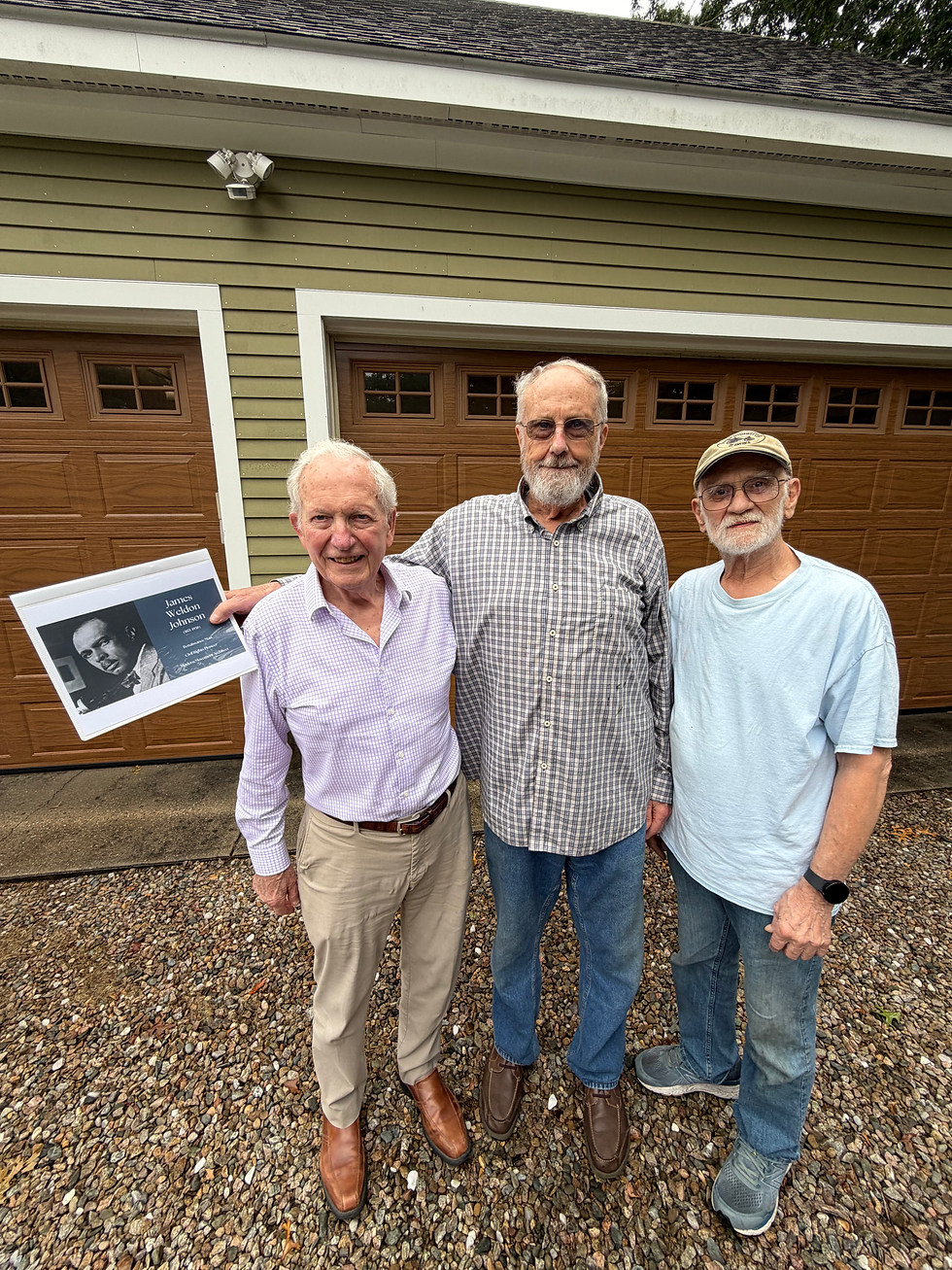
All 4 owners of Grace's Ford, including James Weldon Johnson
Before they left, the three living owners stood together for a photograph beside a portrait of James Weldon Johnson. From left to right, as they put it, all four owners of the car.
It is fitting that the story found its way home through "Lift Every Voice and Sing." The song asks us to remember "the faith that the dark past has taught us." A car is a humbler thing than a hymn. But this one carried a gift from a husband to a wife, a receipt in her own hand, and seventy years of one man's curiosity.
The James Weldon Johnson Foundation is now in conversation about the possibility of acquiring the car. If it happens, Grace's Ford will come back to Great Barrington, a short drive from the cabin where James Weldon Johnson spent his summers writing.
Bruce Wood came to the door to cross something off his bucket list. He may have started something far larger.


